
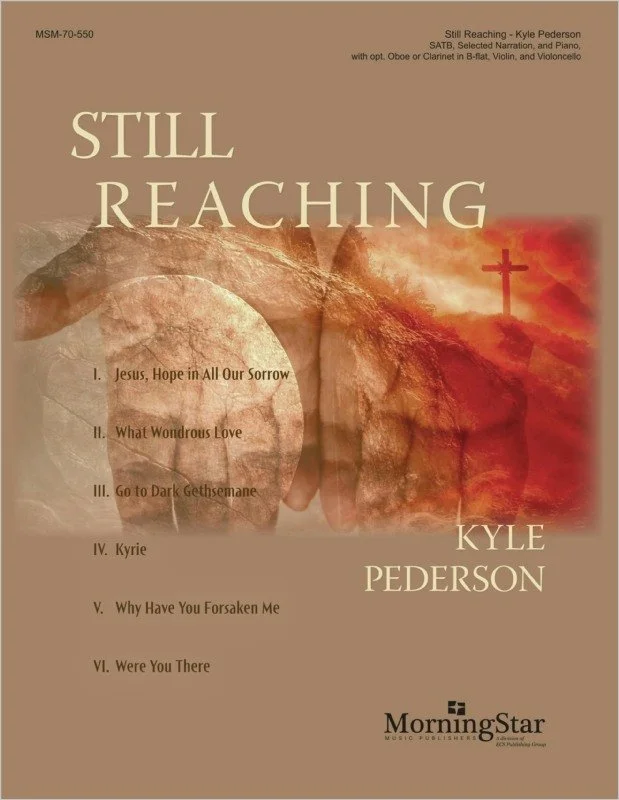
Still Reaching
Still Reaching
Kyle Pederson (2026)
Music: hymn arrangements and original music
Spoken Word: Shanelle Gabriel
Texts: adapted hymn texts and new texts
Length: Approximately 40 min total:
~30 min of choral singing (5 movements)
~10 minutes of scripture/narration in between movements
Instrumentation Options:
1: Piano only
2. Piano, violin, cello, oboe/clarinet
Commissioned by:
This work has been made possible through the generous support of the following choral directors, for whom I’m deeply grateful:
Douglas Boyer, Texas Lutheran University, Seguin, TX
Michael Culloton, Trinity Lutheran Church, Moorhead,MN
David Erwin, Ladue Chapel Presbyterian Church, St. Louis, MO
Shaun Halland, Shepherd of the Hills Lutheran Church, Shoreview, MN
Mark Kemp, Myers Park Presbyterian Church, Charlotte, NC
Andy Muskrat, First Baptist Church, Waco, TX
Cass Roberts, First United Methodist Church, Cookeville, TN
Nathaniel Roper, St. Mark’s Episcopal Church, Brunswick, GA
Christopher Shaw, Plymouth Congregational Church, Wichita, KS
Danny Vancil, Smoke Rise Baptist Church, Stone Mountain, GA
Taylor Vancil, Second Baptist Church, Richmond, VA
James Wells, Brentwood United Methodist, Brentwood, TN
Mark Potvin, First Lutheran Church, Decorah, IA
Gabriel Hiner/Julia Severtson, Decorah Lutheran Church, Decorah, IA
Composer Notes:
Still Reaching weaves together scripture, hymns, and original music in a meditation on the final days of Jesus’ life—exploring themes of love, service, grief, betrayal, and the quiet persistence of grace. The title evokes the posture of Jesus throughout Holy Week: reaching to wash feet, to share bread, to forgive, to surrender. Across time and silence, Christ is still reaching—toward us, and toward the world he loves.
PERFORMANCE NOTES:
Prologues:
The movements and prologues/underscores are designed to be performed without major pauses between them (attacca). It is preferred that the pianist begin the underscoring between movements immediately after the preceding movement finishes. If necessary, the pianist may repeat the opening measures of the underscore (or slow them down) while the narrator gets into place. This is preferable to long periods of silence between movements.
There’s only one line (“It is finished”) for the narrator in between the final two movements. It is recommended that the narrator get in place during the cacophonous build up on the last two pages of Why Have You Forsaken Me, so they are ready to deliver that line immediately after the piece concludes, just prior to the low octave piano hits that begin Were You There. If you’d prefer to have the piano hits begin and the narrator walk into place at that point, it is recommended that you add an additional few measures of piano hits before the soloist begins.
Adaptations:
You are welcome to make this work your own.
You may adapt the narration/scripture passages (selecting alternate passages, utilizing a different translation, creating your own narration, etc.)
The entire work will likely run about 35-40 minutes, from beginning to end. You are welcome to augment the work in any way you’d like, adding a congregation hymn, a sermon, prayers, etc. If you add these elements before Still Reaching, it might be effective to conclude the service with a stripping of the altar at the end of Were You There, with the piano continuing the octave hits, and the congregation leaving in silence.
You are welcome to incorporate the video projection files provided, or utilize video projection of your own choosing (or choose not to include any video projection).
Each movement may be performed individual, or in any combination you choose throughout the church year. When performing Still Reaching, you do not need to include every movement.
Movement-specific notes:
Jesus, Hope in All Our Sorrow
If possible, start the piece with a chime, bell, or tone chime (though a piano hit will work if those aren’t available).
You’ll notice that the narrator speaks three times in the beginning of this piece, with the choir singing before each. You are welcome to include additional narration (either in frequency or duration), repeating the underscore as often as needed and/or adding additional refrains.
Kyrie
Aim to relax into the rhythms as much as possible so it doesn’t sound stilted.
Were You There
You are welcome to repeat/stretch the ending piano octave hits if you’d like to add a dramatic element, silence, etc. at the conclusion of the work.
Video Projection Overview
Artwork/Video assets can be found in the complimentary downloads under ARTWORK PROJECTIONS at the following link:
A few things to keep in mind:
Cue sheet: This is a document containing the texts of the movements, with slide transitions clearly indicated. Your tech coordinator will be able to run the projections even if they do not read musical notation.
You’ll see a host of .mov files—these are the individual slides for each of the 6 movements in Still Reaching. These are the files that your tech coordinator will need as they build out the project (these files should work perfectly with ProPresenter, MediaShout, or whatever video platform your church uses).
The .mov files have demo audio included, in case that’s a helpful reference point as you build out your presentation. Be sure to mute the audio when performing live with the choir.
Slides are designed to encourage reflection/introspection. Slight motion and color variation as the slide progresses...nothing frantic. The "action" is intentionally minimal so that the focus can be on the music and choir; the projections are designed to help the experience be more immersive.
The color red is integrated throughout since that is the liturgical color for Holy Week. It also provides a nice through-thread connecting the movements and slides together.
You are welcome to integrate the projections in whatever way makes sense for you. They are designed so that you can have a continuous visual element from the moment of the opening chime/piano all the way to the final piano hits at the end of Were You There (with the "Home Slide/Animation 1" slide running during the scriptural transitions between movements). But if you'd prefer to not have projections in certain movements or transitions, that is totally your call to make. Or, you may certainly augment these projections with other slides your tech crew designs.
Tempo: If you take the tempo a bit faster in any given movement, the slides will still work perfectly. We have ensured that nothing "critical" happens at the very end of a slide...so if a slide transition needs to happen several seconds earlier, we have accounted for that. Similarly, if you take the tempo a bit more slowly in any given movement, no problem at all. We have "padded" the endings of each slide with about 15 extra seconds...so everything will still work well. Even if you go MUCH slower and reach the end of the extra padding, that won't be a problem. Simply have your tech coordinator pause the slide as it approaches the end, or create an "end on still image" parameter so it stays on the still image at the end and doesn't loop back to the beginning of the slide (tech crews do this all the time).
ABOUT EACH PIECE:
Movement I: Jesus, Hope in All Our Sorrow
This piece is the opening movement of Still Reaching, an extended Holy Week work. Narration is woven throughout the opening few pages, and the entire piece explores themes of hope in the midst of grief, and promise in the midst of woundedness.
Movement II: What Wondrous Love is This
Movement III: Go to Dark Gethsemane
Movement IV: Kyrie
The refrain is a meditation on Kyrie Eleison (Lord, have mercy). The verses juxtapose the Passion events described in the gospel texts with our similar contemporary struggles with violence, betrayal, judgement, and mockery.
Movement V: Why Have You Forsaken Me?
This is the penultimate movement in the extended Holy Week work, Still Reaching. This setting of the last words of Jesus captures the turmoil of these final moments, building in tension to a cacophonous ending.